
#38: How to Lead Without Being the Hero
Episode 38 | 30 Minutes | March 31, 2025
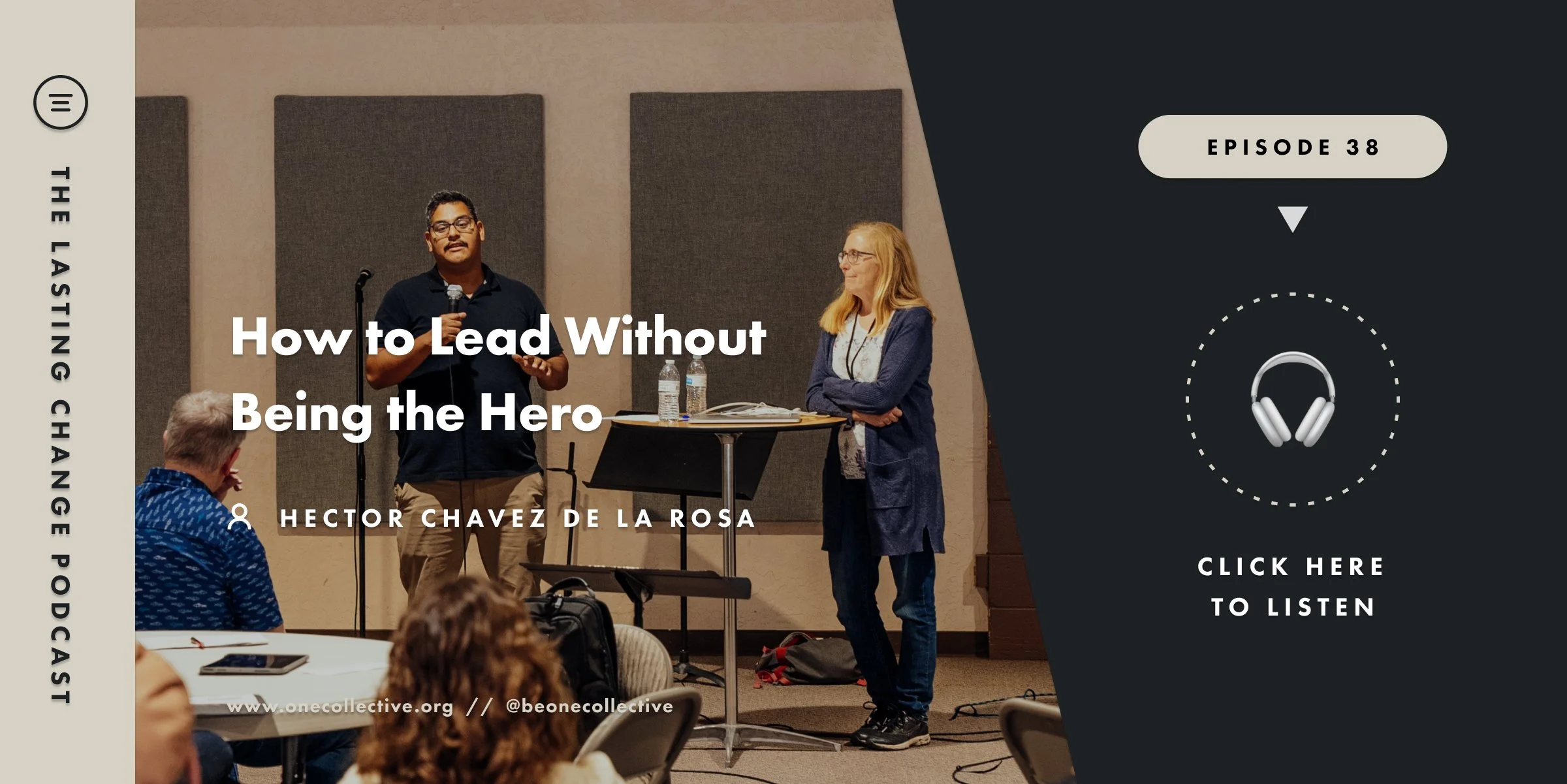
Most of us want to help, but it’s easy to step in like the hero and accidentally keep people stuck.
In this episode, Scott Olson talks with Hector Chavez De La Rosa, a One Collective Catalyst, about a different kind of leadership: coming alongside in ways that help people rise up. Hector shares the idea of being a “window and a mirror”, showing others what’s possible while reflecting hope in a way that feels possible. You’ll hear how his story, shaped by hardship, military service, and good mentors, led him back home to build lasting change through local ownership. Listen in and consider what it could look like to lead without being the hero.
In this Episode, you will learn:
How to lead without being the hero and still create real change
Why local ownership is the goal, and what success looks like when residents lead
How to “be a window and a mirror” so people can see what’s possible and believe they belong in it
-
Hector Chavez De La Rosa is a Fresno native and One Collective Catalyst serving in the same neighborhoods where he grew up. After serving in the U.S. Army as an intelligence analyst, he returned home to help build sustainable, community-led change. Today, he focuses on developing local leaders, strengthening partnerships, and expanding opportunities through workforce training.
-
Okay guys. It is 2016. I am in Fresno, California about to meet one of our brand new leaders in one collective. His name's Hector, and he's a local Latino man. He's grown up in Fresno. He's been there his whole life. And I say, Hector, take me to the best taco place in town. Well, I think that we're going to arrive at some elaborate looking taco place.
He takes me to a gas station and I think that he's going to get gas in his car, but we get out of his car, we go into the back of the gas station, and I will be dipped. 📍 The world's greatest tacos.
Mm.
welcome to our podcast today, and to those of you that don't know what the heck I'm talking about, welcome to the Lasting Change podcast.
I'm Scott Olson, and in every episode we try to explore strategies. For creating sustainable and holistic change around the world. And by listening, we hope that you'll gain valuable insights to drive change in your community, your career, your family, in a holistic and sustainable way. Today, I am thrilled to have the King of Tacos, the leader of leaders, my dear friend from Fresno, 📍 California, Hector Chavez Delarosa.
Did I say all that right? Thanks for having me.
It's good to have you here, brother. How are you?
I'm well getting over a little cold from last week, but man, firing on all cylinders. Glad to be talking with you.
I did not know people in California got colds.
Anything below 60. Yeah, we Oh yeah. Freezing. Well, Hector, you work in Fresno, California and you're part of One Collective, and today we want to talk to you about your role as a catalyst, which for those of you that's listened before, that is the critical role in one collective. It's the person who, who plays the lead role in our communities around the world.
so Hector, let's, let's just talk a little bit before we dive into your particular role, just tell them, give 'em a brief intro. Who is Hector?
Yeah, so, uh, Hector Chavez de La Rosa a lot more than my last name. It's always fun that way to surprise people. born and raised in Fresno, California. I actually was born, in one of the communities that we serve in so deep roots. I was raised by a single mother who was a farm worker and a waitress by night. Always knew, uh, we wanted more for ourselves.
So was able to live truly the Fresno experience. and yeah, grew up in one of the neighborhoods we serve in the low community and.
hey Scott. I'm Hector Chavez and I'm here in Fresno, California. And, uh. Goodness, I love this place. Um, I grew up here in Fresno and left, uh, for the military for a while and returned, and I just saw a lot of good work, being done and, but still there was a lot of deficit.
Yeah, absolutely Scott. So my name is Hector Chavez and I'm a Fresno native. born here and currently I serve as a catalyst with one collective. I've been with the organization for going on 11 years soon, and have been able to join the organization and become a catalyst in one of our communities. we believe in bringing people together.
No one person, no one organization can do it all and especially not do it well. we believe that. There's many ways to do it, but this is, trailing
So Fresno to me is a place that is, right for the Lord to work.
Hey, Hector, give us a brief overview of who you are and what you are doing.
Yeah, no, you're good. Uh, like every community around the world where we work is different, but what we try to do in every community has this, has a very similar style and approach, which is to go in and assess what are the needs, what are the assets, what are the, what are the struggles, and how do we tackle 'em given the resources that we have at our disposal.
Hector, you mentioned that you spent some time in the military. How did that shape you? How did, how did that shape, even the way you looked at the future?
Absolutely. well, I would say that before the military, I didn't really think too much of the future. , I was 17. Graduated high school and I just knew that I wanted to do something. I had, this itch, right? I later learned that it was really a calling that was really put on me, by my mentors at the time, which I had found in the church, I currently still attend and serve.
And one of those mentors was Nancy Donnett. She had instilled in me like this. Active service. Uh, there's more out there. So, so much so that my church family, Nancy included, sent me to Venezuela on a mission service and learning trip for about two weeks when I was 16. So for me, in my mind it was missionary or military.
Both options give you, um, the latitude of travel. But only one of them at the time paid well. So I opted for that. And, uh, the rest is kind of history. I didn't know what I was getting myself into Scott, but it turned out that they thought I was a good fit to, be an analyst. So I joined the Army in 2010 at the age of 17.
And became an intelligence analyst with the US Army. I was stationed, in Oahu, Hawaii, and uh, I served overseas, a couple times in Afghanistan and throughout Southeast Asia in the Pacific Command. But during that time, I was able to see a whole different world, a whole different perspective on life.
a melting pot, if you will, of all of the. Things that are American and all the things that, um, are the American experience. and that really opened my eyes to how different life could be. Um, that was the first time that I realized, wow, the way that the upbringing that I had is vastly different from the upbringing that many people enjoyed.
and I, I joke around, I say, well, I would. Vacation from Hawaii when I had the chance and go back to Fresno. That was my vacation for the tamales, right? And people would laugh, but it was super serious. No matter where I was in the world, whether it's the Middle East and Afghanistan. Six months into a tour, I'd take two weeks and come back to, Fresno to enjoy some good homecooked food, but also to serve.
Because again, I was, I, I didn't know what to do with myself. So I would actually, serve with the youth group that I was a part of then, whether it was winter camp or summer camp, I'd be a camp counselor in between all that. And for me, that was so life giving and already God was sowing those seeds of this is kind of where you belong, friend.
it just took me a little longer to really see that. Uh,
Core of who you are
Yeah, you're, you're good. Um, to get things started, although Michael just erased that, um, to get things started, I'd like to capture kind of the core of who you are. Is there a core question or core belief that you've held that has oriented you towards this work or that you wrestled with?
I think there's a saying for me that I learned, uh, 2009 or 10, it was from a professor. Fresno Pacific University. I heard about it. And, uh, my colleague now Nancy, Donna, is actually the one who shared it with me, and it was this, this framing.
People in their lives need, uh, windows and mirrors.
Windows are folks to show them the expanse horizon and opportunities that are out there, but also mirrors folks that look like them, that have been where they have been, that can show them that there's a different way to be. And I think that this simple concept has really shown me that, the importance of presence in all that we do.
Well, I, what I liked, I, I, I'd love to hear you talk more about the windows and mirror.
Yeah. Um. That's really been a north star for me personally as I've realized where is it that I want to invest my time, my life into? I want to be, sure, an example if that happens to be a byproduct of how I live my life, but I also want to find more windows for people to expand horizons to young people specifically that there is so much more out there, right?
The antidote. To a lot of things is connection, is experiences, is travel, is mentorship, and we wanna be able to provide that, on a personal level. And we do through our programming here in Fresno.
so Hector, when did the, the windows and mirrors that, you said Nancy was the one that initially told that to you, but when did that sink in as like the, that you called it your north star? When did, when, when was that? How long ago in your, in your minister carrier?
I think that that for me really hit home, my second year with one collective where I, I thought I knew what I was getting into. Right. I thought we were an organization that helped people and it was more of a direct service lens. Like we do the food, we do the youth activities, the youth group, but it was so much deeper than that.
As I learned the language of one collective, as I, as I understood the, the ways of Jesus in transforming people lives and communities, I was able to really internalize like, hey. There's more happening here, and it is a responsibility that I now have to find people to be these windows and mirrors for others.
So it's almost an invitation like, Hey, everyone has something to give. But Fresno's a unique place where, you can be a window or a mirror
History/Background to know the community
So what do we need to know about you, um, that will help us understand Fresno better? Like where you, where you grew up, like how does that impact you being a window and a mirror and, and, and what does that, how does that play out in your catalyst role as one collective?
I think on a personal level it definitely leads, to lived experiences. I was born in community hospital, which is a hospital in one of our. Neighborhoods here in Fresno that we serve in, , actively and, extreme poverty. , My mother was a field worker and a waitress at night, so we lived the duality of a, single family household, immigrant family household, uh, trying to make it, and experience, , because of conditions, just The, the gamut of hardship, uh, whether it's houselessness or, domestic violence. Um, so I, I would say that I have A good lens into some of the more difficult things, the insecurities that people within Fresno that we serve alongside Carrie. Alright. And that intimate knowledge and the knowing and the seeing and the understanding, uh, on that level has really led to, um, shaping the way that we approach, uh, relationships and, and long-term sustainable, change, right?
And how we pursue. community with folks, what we view as community with folks, right? Something that can be seen as, just an interaction that's insignificant, I understand is so much more than that and so much deeper. language is different. How we speak to one another, tone, uh, modalities, that type of stuff.
Military
But the military was a fascinating experience for me, Scott, because it really taught me that I was, I was more wired to be, uh, what I would call a generalist, someone who pieces things together. As an analyst, that was my job to piece together different, bits of information, verify and assemble these things so that, generals or flag level officers could make informed decisions on the ground.
Based on my analysis, and that really got me into, thinking the way I do, and it's not so different from what a Catalyst does today.
Generlist
Yeah, let's talk about that. How so? That I, I, I know exactly what you mean by a generalist. sports teams sometimes will have a utility player who can play multiple positions, and that's a great asset and strength to the team. How does that play out for you in that catalyst role, that discovery about yourself?
Absolutely. I think that it lends itself to me seeing the world as just. A place to try things. I'm not afraid to, to fail. I'm not afraid to make connections. I'm not afraid to say, oh, there might be a better way of doing this thing that we've been doing for five years, I think that it really leads to, uh, a little bit of innovation. it leads to new things forming. Bold things forming on the ground here and it a higher level of connectivity really, because now here on the ground in Fresno, um, as an example, today I have a call, a meeting with friends and there are five organizations, nonprofits, place based nonprofits that are all in some way, shape or form involved in workforce development with young adults.
Uh, formerly incarcerated, uh, folks with barriers to employment. Um, they expand the gamut and we're all convening together to talk shop. What's working, what's not? What are you doing? How can we work together well? What are ways that we can support one another? how can you guys even go after grants?
Right? That world would've been vastly different for me if I didn't. Believe in making those type of connections right? I would kind of just be in this one lane, but I think that that mentality is limiting in the ways that Jesus can work. Jesus works in all things and if we truly believe that, then it's our our job to go out there and shake the tree and see what fruit falls.
Military --> Catalyst Turning point
So I feel like we have a sense of who you are, where you came from. lots of little anecdotal pieces of your life, and, and now this generalist idea, which is really, really cool. And the way that, the way that sort of toggles into your, your current role, I'm curious what happened, you know, between military and one collective.
What happened that made you say, okay, I'm actually going to, uh, going to, going to leave the military. And at some point you joined one collective. Like how did that decision come about? And, and the reason I ask that is, you know, there are probably people listening to this right now, that are catalyst type material.
that one collective, you know, we could partner with to change communities all over the world. But it does take a certain kind of person. What, what allows you to walk away from what was familiar to you to what is now new? But now you're kind of a bit of a pro at it, but what, what was the, the turning point there for you?
I think for me that there was a couple key things, but one of them was that I. at the time, say 20 14, 15, I was two deployments in, I, was winning awards, doing all the things, running marathons, training other analysts, But inside of me, there was still something that was amiss. You know, performing was kind of what you did, um, executing on orders is what you did.
And, but still, I felt this hole within me and I, I had a tough time, that compounded with the, the, now what I understand would be trauma that, uh, yeah. That I sustained, um, physically, mentally, during my deployment, really had me reorient my life and where I wanted ahead, right? So I'd accomplished all these things, but still there was something missing.
And I knew that if I kept on, because I had talked with mentors, um, at the time, and I knew if I kept on it would just be more of the same.
You get promoted, do a good job, go to another place, do the same thing. and I thought, oh wow, there's gotta be more. Right? I would come back to Fresno, I would vacation from Hawaii to Fresno in between my deployments and see that there was just something missing.
So I think,
I think that at my core. At one point, Scott, I was someone who ran away from a fight, and I think that, that really bubbled up in me where I, I took these, these things I was a part of, internalized them, right? It was like who I was, what I was about. And, uh, that's the good and the bad that I did and some of that in the military.
Absolutely. so throughout my military career I was savvy enough to collect, um, awards, accolades. Promotions. But along the way I also carried a lot of, trauma and, guilt from, just the operations that we were involved in in the Middle East. and I found myself really in late 2014 and just a really dark place, Scott.
And thankfully at the time I had a great chaplain who said, Hey, friend, you've done your part. You've done enough, you've given all there is to give
and it really will only get harder from here if you, um, don't address these things. So instead, how about we medically retire? You like there and then you can get healthy and then you can do this life thing, get married, have kids.
So I give it up to that chaplain, uh, chaplain Kirk. Um, if you're listening, love you, man. But that,
that gave me an opportunity to restart my life. So I was medically retired from the military, um, in 2015, and life just started on an upward trajectory from there.
There was a need, there was a felt need, and there was a, visible need for, workers to come alongside and do it. And I said, oh.
You know, I, I was asked, why not you? And then I started asking myself, why not me? You know, I've done all these things, all these accolades, I've worked with the defense department, F-B-I-D-I-A, at this point, I've lived this whole other life.
It's like, what's stopping me from changing my community? What's stopping me from, getting involved, bringing back everything that I've learned, acquired, uh, know, am learning, and using it for the good. Uh, using that to continue to serve in a different capacity.
The trauma
Hector, is it okay? can we dig into the, the trauma a little bit? I, I want to see how that, how that played out into, those life choices that you were making at that time. Yeah, because you're not somebody who runs away from a fight. You're, that's not who you are. But it definitely, in some ways must have impacted the types of decisions you were about to make
Yeah,
and also in sharing your life with other people in a different way.
I'll try to get you back into it. So, so as you were talking, I was Hector I was thinking about, you know, I mean there was definitely some, some darkness happening for you as you were at, at like, I think maybe 2014, 2015. Can you talk a little bit about more, more about that and, and how that trans, or how that, the role that that played in future decisions you were going to make?
Becoming a Catalyst
That's really a thank you Lord kind of story. So, thank you for sharing that. Hector, I want to, I want to jump a little bit. I mean, we've identified that you're now with one collective, you're a catalyst. We've ident, we talked about your military career and some of that transitions and why that you made the choices that you made, how.
In the heck did you join one collective and wind up being a catalyst. You're on staff, but now you're, now you're the the head dude man. Like how did that happen?
Yeah, just as things happen, right by some, by coincidence, some God's sense of humor and divine planning. Right. So I've only lived in two communities in Fresno, the Lowell neighborhood and the Hi neighborhood, and they happen to be about an eight minute drive from one another on one of our main arteries, Belmont Avenue.
And as I'm working and joining one collective and, buying in and kind of, Going through the things that we, we do, you know, one collective, we have these programs, we do, we believe in food freedom and forgiveness. We were doing that and really well, right? I, I still had this, this longing like there's, there's more, there's more that I feel like I can provide, I can do, there's more that I can be involved in.
and. I get this call or this knock, I should say. It's more of a call, right? These days it's probably a text, but um, these community members in the Hidalgo neighborhood, the Contreras family reach out and say, Hey, we'd love to invite you to dinner. Now a little background on them. They've been missionaries in the Hidalgo community and in Fresno with World Impact for over 20 years have raised their children there, have done everything from camps to bible studies to opening their homes to to living.
Incarnation. They, they, they breathe it, right? So when they invite you for dinner, you're gonna go, 'cause you know the food's good and you know the conversation's going to be better. So there I am, I show up and we get to talking and we all like each other. So then the questions posed, Hey, would you be interested in doing some work here in Hidalgo?
'cause we, Have been doing this for a long time and we're in a different season in life. And I say, okay, what would it look like? And they say, well, you tell us. So in my mind, in my back pocket, I got the The ease, right? The one collectives enter, engage, all that good stuff. And I say, well, this is what I would do.
I propose our general plan and how we do things. And they say, we really like that. You're not coming in here to tell residents and people what to do. You're gonna come alongside, you're gonna work alongside, you're gonna live alongside, and we like that. So if you're open to it, come on down. And that is how our second community in Fresno opened up and how we expanded after more than 15 years.
I love it. So the model works. The model's attractive and thank the Lord for that.
Okay. And, and what I like, is that that was a couple who'd paid their dues in that community, you know, 20, I think you said 20 years. And even they could spot it because the thing about the thing about what we do, it is a little bit, um, contrary to the, the way a lot of organizations work, which is to go, go in and set up your, your big banner over the community and not come alongside.
And that is a high value for us. And you have absolutely, totally mastered that and modeled that, , for all of us. That's why when we get together, sometimes I'll put you up in front of the whole audience and say, Hector, talk to us. this is cool.
Feel currently
Okay, so, now that you've been serving as a catalyst for a while? What's it feel like?
Well, it felt foreign at first. There was a lot of, a lot of differences with leading in the military versus leading in the civilian world. there was a lot of, uh, gaps that I had initially that, I reached out to my one collective fellow catalyst and said, Hey, how do you do this? How do you lead a team?
How do you have a hard conversation? And I would get great feedback. Decades of lived experiences poured right back into me. And I think that that was really special and really unique about our catalyst team here in the United States, where we have this, this, this reach back, this ability to learn from others and implement.
So again, because I'm a generalist, I have no qualms with implementing and trying out these things that, , I've been, guided through. , So I think that was really helpful, , in. Really learning the ins and outs of being a catalyst and you got the paperwork and then you have the emailing and then the, the different, the hosting of teams, which again makes us very different from just your direct service nonprofit.
Like we're open, come and see the work that we're doing. It's an open invitation.
Good catalyst CTA
You know, you said something I want to, I just wanna insert, insert here that, that just feels like it may be helpful to somebody who's listening to this and they're thinking about, you know, whether they could be a catalyst or not. I, I've been doing this for a long time, and I remember I've, I've only served with two organizations, but a long time ago there was this guy who'd become this legendary worker uh, in, in Eastern Europe.
And, I know that my old organization had tried to recruit him, but he went with another organization and I just asked him, I said, Hey, because he'd become a good friend of mine. I said, Hey, Dennis, why? Why didn't you join us? He said, well, you guys offered me a job, but the other organization told me they trained me. And I remembered that and when we started building one, the one collective model, the idea of our training is so, I mean, it, it is just such a high priority to, to be able to give to guys like you and all of our staff around the world, the kind of training that is gonna be, be able to maximize your impact.
And I'm so glad you mentioned that because we do have. We have an amazing training department. We have amazing cohorts. We have all kinds of people that have that collective decades of wisdom that can pour into each other. And that's the, that's the spirit here. So if you're out there and you're, you're thinking about, could I be a catalyst?
Or you feel like maybe you don't have the, the gifts and skills to do it, but you. Might, this is the place to be because there is a extensive training network, that's made people like Hector Great. Hector was great, but he's, he's incredible now. and part of that is the way that we've been able to invest in him.
You agree with that, Hector?
Oh, wholeheartedly. And the way that we invest in people changes, right As the needs change. And I think that even as a catalyst, I'm comfortable with saying I can speak into, Hey, I need this type of support, and quickly I'm supported. So
yeah.
Working on in community now?
that's good. That's good. So you've been at it for a little while. What kind of things are you working on right now in your community?
Oh my goodness. So we. I'm proud of this one. We have moved from running one of our food distributions to having the community lead it alongside the school district, so now there's local ownership. A lot of our wins over the last two years have been transitions to local leadership, and now I'm able to come in and if there's issues, problems.
Someone needs more bags, then I step in. But that has allowed me to step back and look at the bigger picture and focus on that. And that's what we're doing in our workforce development. So we run cohorts with young adults, and we do Chalmers based, uh, training with them eight weeks, financial literacy.
We do emotional regulation and health. That some of our one collective workers here, lead and then financial literacy. I think I said that. Sorry. But that has really opened the doors to realizing there is just such a hunger for. Not only young adults, but parents and families to be invested in. Like, the posture is there, people are ready and open to, to take this thing further than, than we know.
And they just need an opportunity to be equipped and trained and sent off in the right direction. And that's something um, we're really excited about. and if I can share, That is transforming in this coming year, in 2026 to 2027 into potentially an endeavor to stand up a, uh, CNA program in our community.
The first of its kind in south southeast Fresno.
Goal of model is to hand off
So Hector, you know, one of the things that you said, um, a a little bit ago, um, was about our model of coming alongside, uh, the community and people in the community. And you and I know through the training that we've been through and that we do, is that
ultimately one of our goals of coming alongside people in our communities that we serve in is to watch them grow and eventually take on the responsibilities that we trained them to do. you know, in our model, when we go into community, there's typically people there who are passionate and excited about seeing change happen in the community.
Yeah, but the reality is they lack training, uh, and they lack resources. And that's one of the things that you do as a catalyst in one collective. You bring training and resources into a community that raises up leaders and gives them a hunger to make a difference in their community. and, and at the end of the day, success for us is were we able to work ourselves out of a job?
Yeah. And somebody else can do what we've been doing and we can be repositioned maybe to do something else. So have you been able to see some of that in your community where, where people are rising up and, and taking over much, you know, more and more leadership.
Absolutely. We've been, we've really had the privilege of seeing folks from within our community, evolve in the ways that they participate, they, they want to change their communities. So everyone's different And figuring out at first what people actually want to get involved in is key.
Right. What lights them on fire, When we have, we bring in partners like, uh, every neighborhood partnership do asset-based community development, like workshops, teaching people from the ground up. What is asset-based community development? Again, that's just the nonprofit world for, uh, ICT. How does that function?
Right. What are you interested in being involved in? We have some residents that, love green spaces. Their passion is making sure the kids have spaces to play and just be kids. So some of these volunteers and community members now, assist with our Saturday sports. Right. And then we have residents that are super into, battling or combating food insecurity, came as receivers and now they lead the charge. They're in charge of making sure that, the widow that is down the street that is in a wheelchair or is wheelchair bound is getting sustenance for the week on a Friday. Right. They're in charge of making sure that that happens. So there's this, uh, um, sense of ownership really that is palpable.
There's other individuals that are, politically active. They want to advocate for their community. They want safe to school routes. They want speed humps to deter the car accidents that happen, right? So there's levels to this thing, and we're only scratching the surface.
Because now we have a younger generation that is becoming 18, 19 year olds that I met when they were in middle school, and they are now active and involved and have a hunger for change, they don't just wanna leave for a better part of town in the suburbs. They wanna stay because they believe in what we do and they wanna be a part of the transformation.
So it's our job to help them figure out what that looks like for them as individuals.
that's good. Good. Thank you, Hector.
Wow. That's great. Lots, lots of stuff happening. Any other big things in the horizon that you're thinking about as you look out into the future?
More work - anti trafficking work
Definitely, we are really excited to work more closely and expand the, the connectivity that we have locally here with, um, our anti-trafficking work. So relatively new for us here in Fresno, not for Fresno. Fresno's had a historic, just battle with, trafficking, but it's only been recently that we've had a team member.
, Join us, who is helping to bring capacity to existing organizations doing anti-trafficking work, whether it's education, like on the ground, meeting with, um, workers, the ladies, or, just doing some prevention. So we're excited for the direction that that's going in. Again, we are acting as a sinew connecting.
Things that have already existed, but maybe for whatever reason, whether it's a relationship that was lost or trust, they're just not connecting, right? So that is our hope and goal, to reconnect things embolden these organizations, to do the good work that they can do. So expanding our team in that way.
What would you say to other Catalyst - CTA
Hector, you've done two things today for us, uh, by being on this podcast. One, told us your story and the transition, and you've, you've helped us understand your role, your life as a ca catalyst with one collective. The second thing you've done is there are probably some people out there listening who are, who are saying, huh.
I wonder if I could do that. And the answer is for some of you, yeah, you probably could. What would you say to them, to that person who's saying, maybe I could do this, maybe I could be a window and mirror. Um, what would be a next step that you would, that you would recommend that they take?
Well, firstly, I would say listen to as many of these podcasts as you can. Because you will gain so much insight as to how we do what we do and the why after that. If this is something you're still super charged about, reach out to one of our mobilizers and they'll walk you through the steps of potentially how to get involved, where you would serve They'll field any questions that you have. We have a great team. The mobilizers that I had are still my friends.
Closing (Needs work)
That's good. That's really good. Well, buddy, thank you for being on the, uh, the podcast today and, uh, sharing your wisdom, sharing your journey. It's, it's been filled with joy and pain and, and learning and growing, and here you are and I hope you always will remember that I. Probably one of your biggest fans and always believe in you.
And it's always such a joy to see you and to be, it's better to be in the same room when I can get like a bear hug that typically lifts me off the ground. Um, but I, I love you, man, and I, I appreciate what you do for one collective, what you do for Jesus, and, uh, what you're doing for the people in, uh, in, in, uh, Fresno and Lowell and the whole, the whole community around there.
So thank you my friend. Much appreciated,
Thank you, Scott. Thanks for having me.
gladly.
Good from Scott responce to locals taking ownership
Michael. Yeah, Yeah, Hector, that, that's just powerful to hear the kind of stuff that you're seeing happen. And I love how you talk about the kids you knew in middle school are now the ones who are rising up. And, and before you know it, they're gonna be. They're gonna be as old as you, and they're gonna be making a difference in their community, even, even with greater, uh, experience and strengths because they've, they've been trained, they've been growing into, into, uh, positions of leadership.
So, Hector, thank you for being there. Thanks for giving your life to, to uh, to serving people. Thanks for serving. Serving your country. Thank you for serving at one collective and giving 'cause. What you're modeling in both of your, your jobs is you're modeling giving your life away for others. And I respect and honor that so much.
And, uh, I pray that people who are listening to your story will be moved by it and wanna be challenged to that same question. What do I do with what I've been given? And, uh, how could I use it for. Bringing glory to Jesus. So thank you my brother, and uh, it's so great to have you on the podcast today.
Thank you, Scott. Thanks for having me. Anyone listening, you can do it too.
Amen. And to those of you that are listening, thanks for joining us on the Lasting Change podcast. I really 📍 hope that the insights and strategies shared here that have have left you feeling inspired and empowered to create some meaningful change in your own sphere of influence. You see, lasting transformation isn't easy, but it's possible when we approach problems with creativity, humility, and a long-term perspective.
If you want to dive into the ideas that we discussed on this show, head over to one collective.org/podcast and it's there that you can find links and resources to, uh, past episodes like Hacker talked about and ways to connect further with our 📍 community. Okay guys, thanks for being here today. Take care.
Bye-bye.